TL;DR
- Slow feeding means the beans enter the burrs a few at a time instead of as one full dose.
- At the same grind setting, slow-fed coffee comes out coarser, with fewer very fine particles, so your shot or brew runs faster.
- To get back to your usual flow time, grind finer. Once dialled in, many coffees taste clearer and sweeter, sometimes with a little less body.
- Start by grinding a few steps finer than usual and adjust by taste and flow time.
What slow feeding is
With a normal single dose grinder you pour the whole dose into the hopper and the burrs pull it through in a few seconds. With slow feeding, the beans are let in gradually, so only a few beans sit between the burrs at any moment.
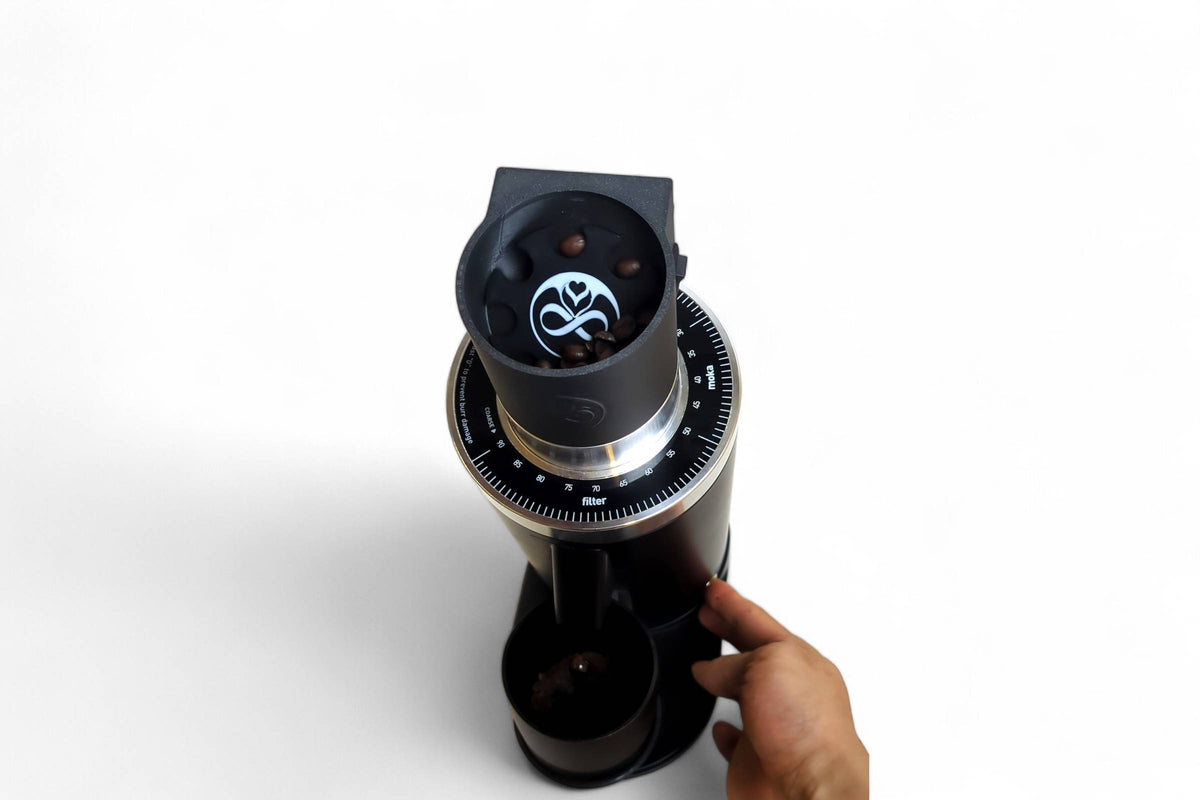
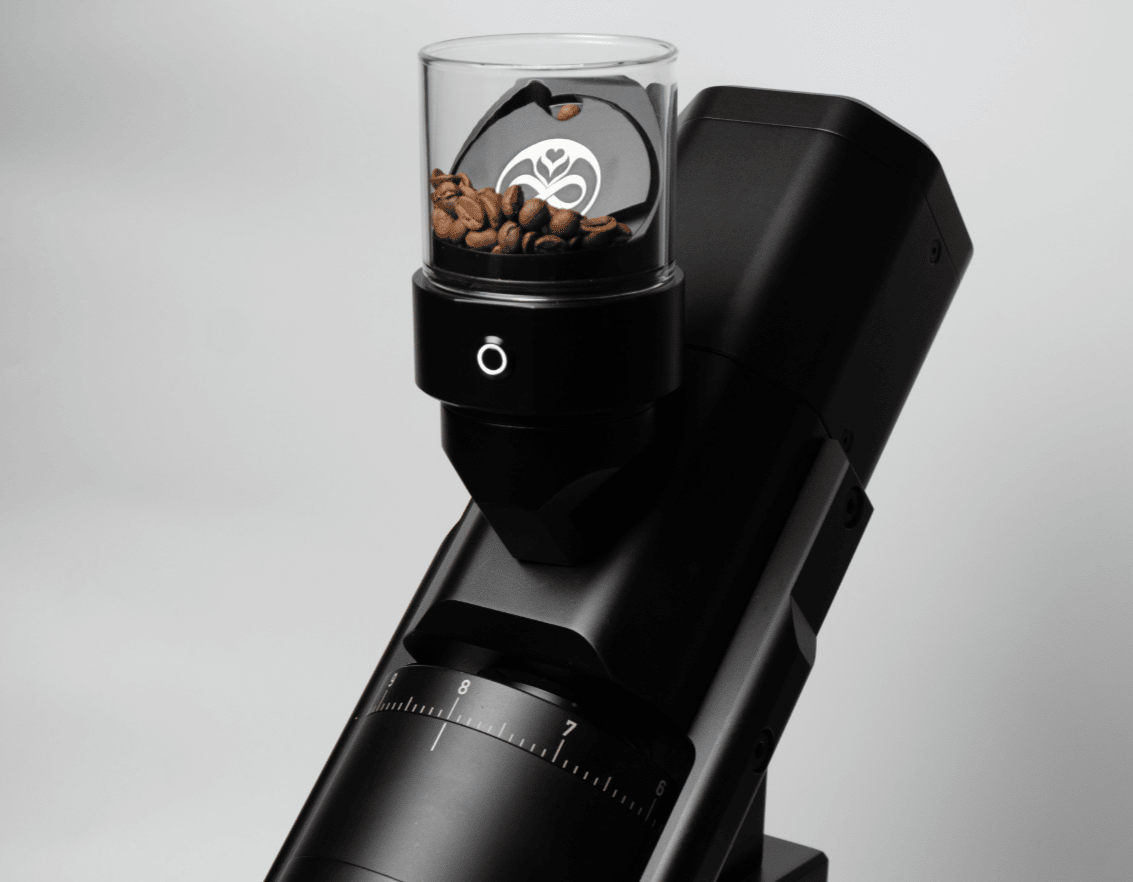
Home baristas first did this by hand, dropping beans in a few at a time. Videos by James Hoffmann and Lance Hedrick helped make the technique popular. A slow feeder does the same job automatically: a rotating disc under the bean container lets the beans through one by one at a steady rate.

What changes in the grind
With a full dose, the burr chamber is crowded with beans. Fed one by one, the beans pass through the burrs with much less crowding, and that changes the particle size distribution.
The Swiss coffee school Kaffeemacher measured this with a particle analyser at the ZHAW Coffee Excellence Center. They ground two espresso coffees on a DF64, once normally and once slow fed, at the same grind setting. One of the two slow feeding methods they tested was an electric CremaLoop slow feeder.
| Share of fines, same grind setting | Normal feeding | Slow fed by hand | Slow fed with the electric feeder |
|---|---|---|---|
| Coffee 1 (Apas) | 33.0% | 23.9% | 26.2% |
| Coffee 2 (Limontitla) | 33.4% | 28.4% | 29.3% |
So at the same setting, slow feeding clearly cut the share of fines, and the grounds came out coarser overall.
What changes in the cup
Coarser grounds mean water flows through faster. In the Kaffeemacher test, one espresso dropped from about 26 seconds to about 10 seconds at the same setting and was under-extracted. Grinding finer brought the shot time and the extraction back to normal.
Grinding finer also brings back some of the fine particles, so slow feeding is not simply a way to have fewer fines in the final recipe. What it changes is the shape of the grind, and that shows up in the taste. In their tastings:
- One coffee tasted clearer, sweeter and more acidic, with less body and texture.
- One coffee scored clearly higher slow fed (32.5 against 27.5 out of 36) and was described as much more floral.
- One coffee was hard to dial in and did not improve.
A slow feeder adds one more thing: the feed is the same every time, so a recipe that works today is easier to repeat tomorrow.
How to dial in with a slow feeder
- Start finer. Expect to grind a few steps finer than usual to reach the same flow time.
- Pick a feed time. Our slow feeders feed 25 g in roughly 60 to 120 seconds, depending on the beans. Slower is not always better: start in the middle and taste.
- Change one thing at a time. Adjust grind size first, then feed rate.
- Judge by taste and time. Look for more clarity and sweetness. If the cup gets thin, go a step finer or feed a little faster.

When we tested disc inserts on our earlier slow feeder, 18 g took 20 to 30 seconds with the standard 8-hole disc, 40 to 50 seconds with 4 holes, 80 to 90 seconds with 2 holes and 160 to 170 seconds with 1 hole. It shows how wide the range of feed rates is, and why a fixed, repeatable rate matters.
Is slow feeding for you?
Slow feeding suits you if you single dose, enjoy dialling in, and like clarity in the cup. It takes a minute or two per dose, so it is less practical in a busy café. And it works best on grinders that can go fine enough and hold their setting.
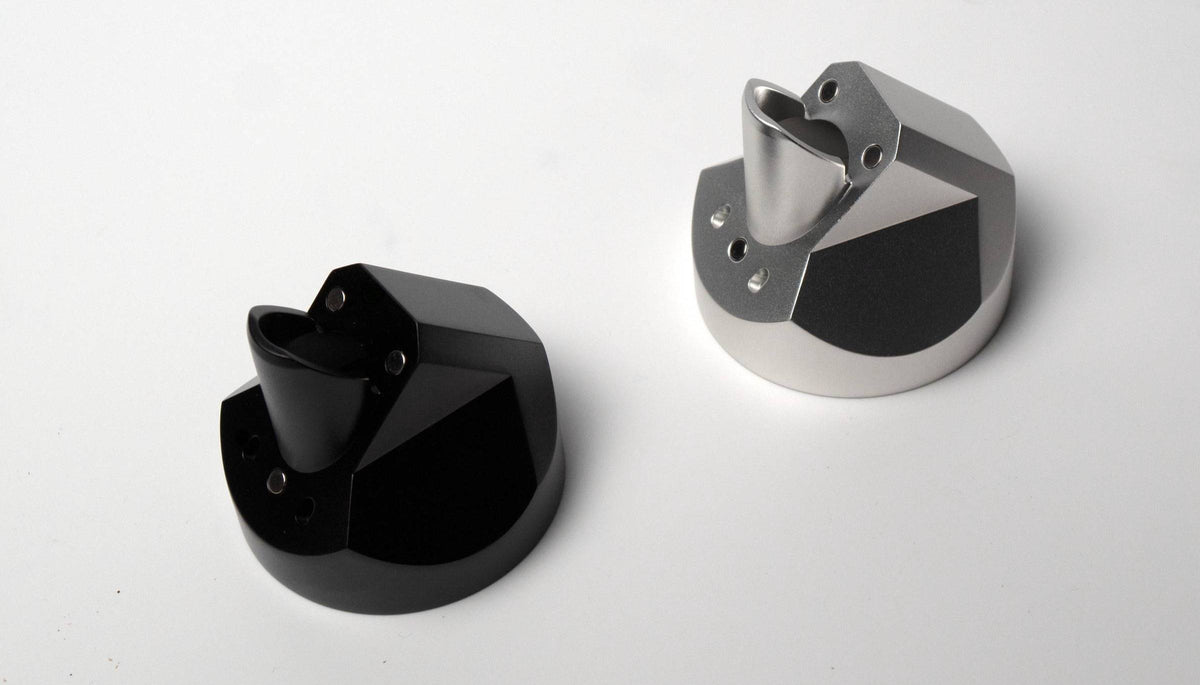
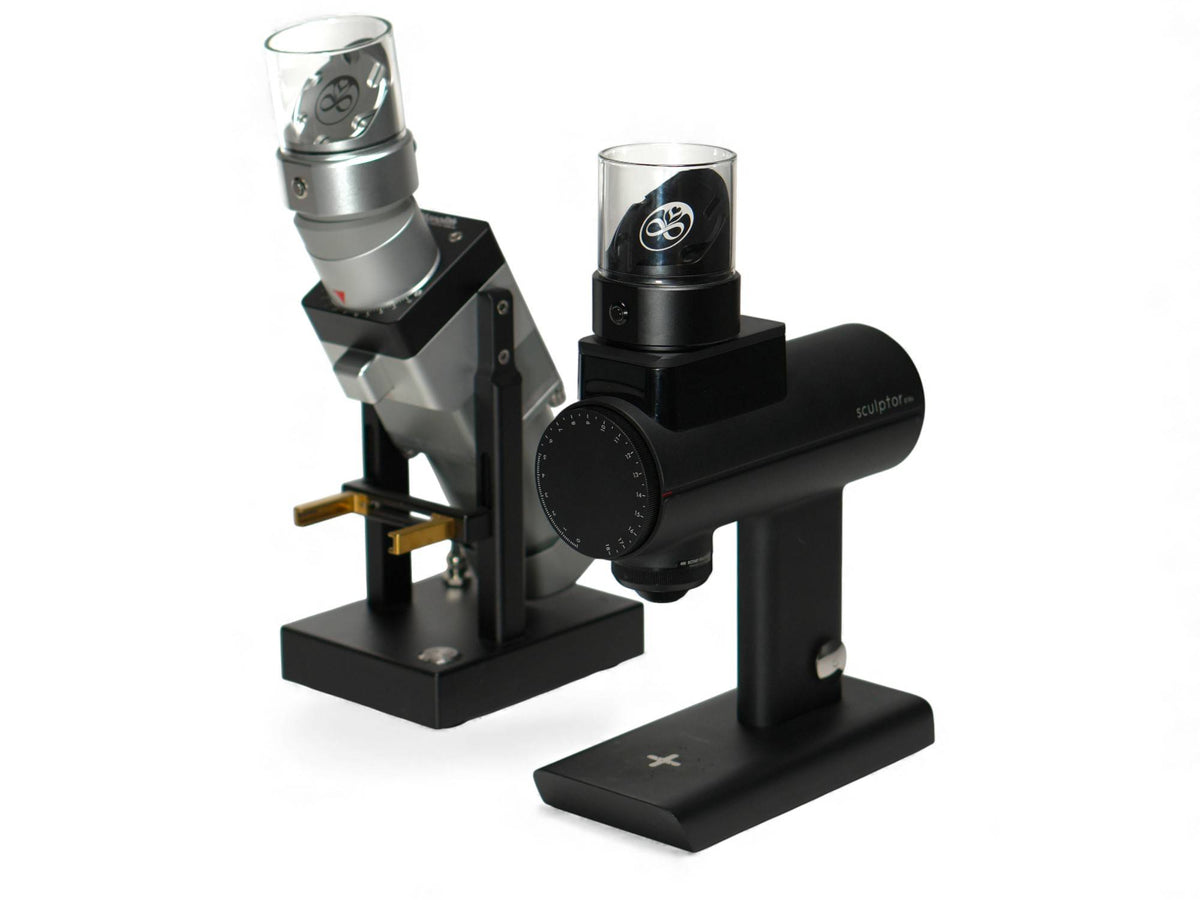
Our slow feeders fit more than 40 grinders. The most common are the DF64 and DF83, Timemore Sculptor 078, Weber Workshops EG-1, DF54 and DF64V, and Zerno Z1/Z2.
➡️ Which slow feeder is right for me?
Frequently asked questions
Does slow feeding reduce fines?
At the same grind setting, yes: in the Kaffeemacher tests the share of fines dropped from about 33% to between 24% and 29%. You will usually grind finer afterwards to keep the same flow, which brings some fines back. The bigger change is in the taste: more clarity and sweetness for several of the coffees tested.
Do I need to change my grind setting?
Yes. Slow-fed coffee comes out coarser at the same setting, so start a few steps finer and adjust from there.
How long does slow feeding take?
With our slow feeders, 25 g takes roughly 60 to 120 seconds, depending on the beans.
Does slow feeding work for espresso and filter?
Yes. Home baristas use it for both. The Kaffeemacher tests above were done with espresso.
Source for the lab results: Kaffeemacher, Slow Feeding, measured with a Camsizer X2 at the ZHAW Coffee Excellence Center.