TL;DR
- The temperature on your espresso machine's display or PID is measured in the boiler, not at the coffee. The water that reaches the puck is often a few degrees off.
- Flavour is sensitive to brew temperature, so a hidden offset makes dialling in harder.
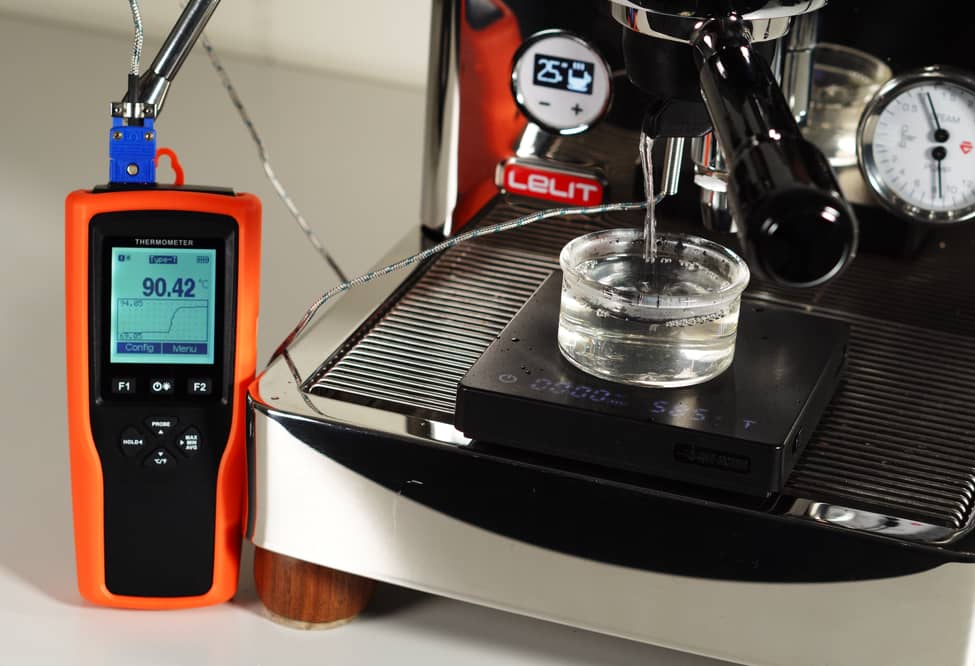
- The Brew Temperature Analyzer (BTA) sits in your portafilter like a coffee puck and measures the real brew water temperature during a shot.
- With it you can find your machine's offset, see how long it needs to heat up, and check how stable it is from shot to shot.
Why the display is not the brew temperature
You have perfected your grind, your distribution and your tamp, and something still feels off. A common reason: the water temperature at the coffee does not match the number on the display.
Most machines measure temperature in the boiler or the heat exchanger. Between there and your coffee, the water passes through the group head and the portafilter, and it loses or gains heat on the way. How much depends on the machine, how long it has been on and how quickly you pull shots one after the other.

Why it matters for taste
- Flavour clarity lives in a narrow window. A degree or two can change how bright or bitter a shot tastes. Seeing the real brew temperature, not just the PID set point, lets you dial it in on purpose.
- Recovery time. Know exactly how long your machine needs to get back to temperature after a shot.
- Heat-up curves. See when your machine is really ready after switching it on.
- Shared recipes. When everyone knows their real brew temperature, recipes from forums and friends become repeatable.
How the Brew Temperature Analyzer works

The BTA replaces the coffee puck with a measuring basket that behaves like one:
- Type T thermocouple with a fast response time.
- Plastic insert with minimal thermal conductivity, so the heat exchange is close to that of a real coffee puck.
- Static flow restrictor that reproduces the pressure drop of a puck, shot after shot, without readjusting valves.
- Magnetic single spout cap for safe, one-handed fitting and removal.
- 58 mm basket for E61 group machines and machines with a similar group geometry.
We developed it over a year, with guidance from the team at Kaffeemacher and feedback from home baristas in our community. You can order the basket on its own, with a 58 mm portafilter, and with a basic or an advanced temperature reader. The advanced reader shows a live graph and logs the data for CSV export.
What is in the box
- The temperature basket with sensor and plastic insert.
- The magnetic single spout cap.
- A set of 10 cleaning needles for the flow restrictor.
Which reader do you need?
- Advanced (high accuracy) reader: single channel, Type K, T and more, 0.01 °C resolution, accuracy ±(0.003 × T + 0.4) °C, live temperature graph and data logging with CSV export. Runs on 3 × AAA batteries (not included).
- Basic reader: dual channel, Type K, T and more, 0.1 °C resolution, accuracy ±(0.001 × T + 0.6) °C. Runs on 3 × AAA batteries (not included).
- Optional 58 mm bottomless portafilter: stainless steel head, plastic handle, one 22 g basket included.
How to measure your machine's offset
- Calibrate your sensor and reader before the first test.
- Let the machine heat up fully.
- Fit the BTA in the portafilter, start a shot and record the temperature curve.
- Compare the stable brew temperature with the display, and correct your machine's offset.
- Repeat a few shots in a row to see shot-to-shot stability.
For a full protocol, the SCA's test methods for competition espresso machines and Kaffeemacher's espresso machine test protocol are good references.
Frequently asked questions
Which machines does the BTA fit?
Machines with an E61 group head and machines with a similar group geometry, using a 58 mm basket. If you have a different machine, get in touch and we will look at an adaptation.
Do I need the temperature reader?
You need a thermocouple reader that supports Type T. If you already have one, the basket alone is enough. Otherwise choose the basic or the advanced reader.
Why not just use a thermometer in the cup?
The water cools quickly once it leaves the group. The BTA measures inside the basket during the shot, where the coffee is actually brewed.
Why does the BTA use a flow restrictor?
Without a coffee puck, water would rush through the basket and the reading would not match a real shot. The static flow restrictor reproduces the pressure drop of a puck, and because its geometry never changes, every test shot is repeatable.